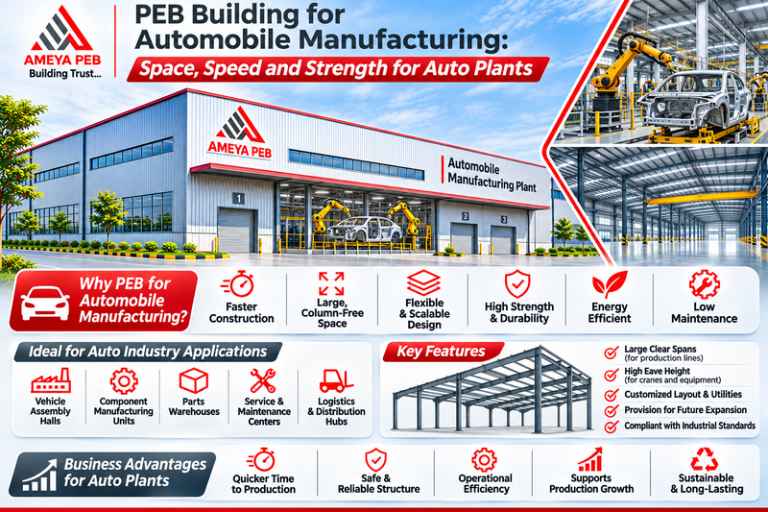
Automobile plants run on precision and flow. Parts move from press shop to welding, painting and final assembly, and the building must support that flow without obstruction. Pre-engineered buildings (PEB) are a natural fit, which is why many auto manufacturers and component suppliers choose them.
Why PEB suits automobile manufacturing
- Column-free assembly areas: Wide clear spans let you plan conveyors, robots and assembly lines freely, and rearrange them when models change.
- Fast construction: Quicker completion helps meet vehicle launch and supplier delivery deadlines.
- Crane and heavy-load support: Press shops and die handling need overhead cranes, and crane beams can be built into the frame from the start.
- Easy expansion: New bays can be added as production volumes or product lines grow.
- Cost efficiency: Optimized steel design reduces material use and construction time.
Areas of an auto plant where PEB works
- Press shop and tool room
- Body welding and fabrication
- Machining and assembly lines
- Paint shop enclosures (with proper design)
- Warehouses, parts storage and logistics areas
- Component and ancillary unit sheds
Design points to plan early
- Crane capacity and duty cycle: Press and die handling need heavy-duty provisions.
- Vibration and machine loads: Heavy presses need suitable foundations and frame design.
- Ventilation and insulation: Welding, painting and heat treatment generate heat and fumes.
- Natural light: Good lighting improves visibility on inspection and assembly lines.
- Clean zones: Paint and final inspection areas may need sealed, controlled environments.
- Fire safety: Provisions for sprinklers, exits and fume control as required.
- Utilities routing: Compressed air, power, ducting and drainage should be planned with the structure.