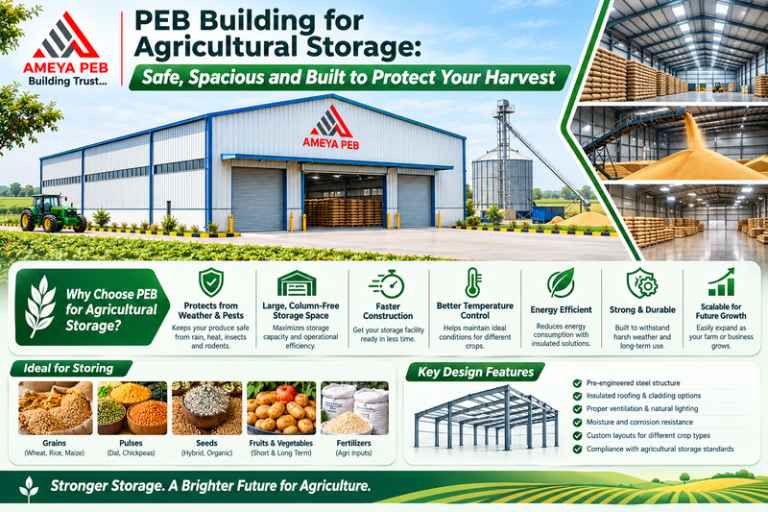
Every season, farmers, cooperatives and agri-businesses lose part of their produce to moisture, pests and poor storage. A strong, well-ventilated building protects both quality and income. Pre-engineered buildings (PEB) have become a popular choice for agricultural storage because they are quick to build, spacious and low on maintenance.
Why PEB suits agricultural storage
- Large clear space: Column-free interiors allow bulk storage, stacking and easy movement of trucks, tractors and loaders.
- Fast construction: The building is ready well before the next harvest or procurement season.
- Weather protection: Coated metal roofing and cladding keep out rain, dust and humidity.
- Cost efficiency: Lower material use and quick erection reduce overall project cost.
- Easy expansion: New bays can be added as storage needs grow.
- Low maintenance: Steel does not rot and, unlike timber, is not damaged by termites.
What can be stored in a PEB
- Grains such as wheat, rice, maize and pulses
- Fertilizers and agri-inputs
- Fruits, vegetables and potatoes (with ventilation or cold storage)
- Seeds and processed food products
- Farm machinery and equipment
- Fodder and feed
Design points to plan early
- Ventilation: Ridge ventilators, louvers and gable openings keep air moving and reduce moisture buildup.
- Insulation: Helps limit heat inside the shed, protecting stored produce.
- Moisture control: Raised plinth, proper flooring, damp-proofing and good drainage around the building.
- Wall loads: Bulk grain pushes sideways on walls, so share your stacking or bulk storage plan with the designer.
- Pest control: Sealed joints, tight doors and rodent-proof detailing.
- Truck access: Wide doors, ramps and loading platforms.
- Fire safety: Clear spacing, exits and suitable precautions for dry, combustible produce.
- Corrosion protection: Fertilizer storage needs special attention to coatings and ventilation.