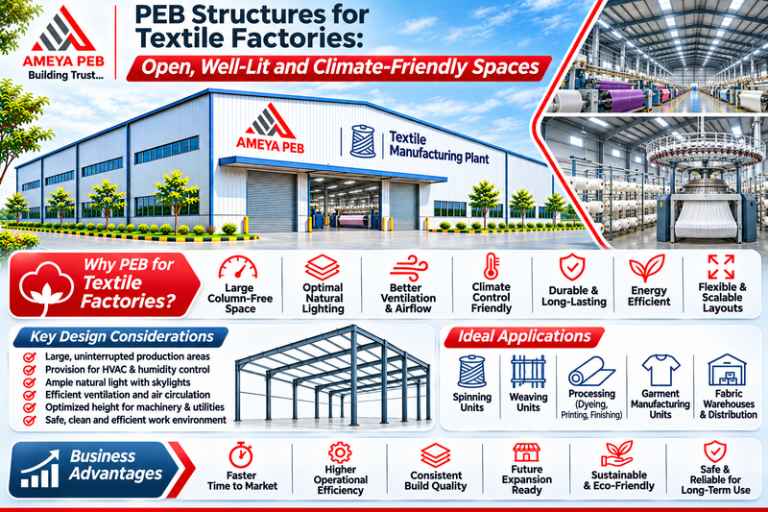
Textile production depends on long, uninterrupted floors, steady temperature and humidity, and good light. Spinning, weaving, knitting and garment lines all need layouts that can change with orders and machinery. Pre-engineered buildings (PEB) deliver this kind of space quickly and economically, which is why many mills and garment units choose them.
Why PEB suits textile factories
- Column-free floors: Looms, spinning frames and stitching lines can be laid out for smooth material flow, then rearranged later.
- Fast construction: A quicker shell means earlier machine installation and earlier orders shipped.
- Natural daylight: Translucent roof sheets bring in even light, which helps inspection and cuts electricity costs.
- Good ventilation: Ridge ventilators and louvers carry away heat and lint-laden air.
- Lightweight structure: Reduces foundation needs, though heavy machinery still needs proper support.
- Easy expansion: New bays can be added as capacity grows.
Where PEB is used in textiles
- Spinning and weaving sheds
- Knitting and processing units
- Garment stitching and finishing halls
- Dyeing and printing sections (with corrosion-resistant detailing)
- Yarn, fabric and raw cotton warehouses
- Packing and dispatch areas
Design points to plan early
- Humidity and temperature control: Spinning and weaving need stable conditions, so insulated roofs and suitable air-conditioning or humidification plans matter.
- Machine vibration: Looms and heavy machines need well-designed foundations, often independent of the building frame.
- Daylight design: Evenly spaced skylights, often with north-facing glazing where suitable, reduce glare and heat.
- Fire safety: Cotton, yarn and lint are highly combustible, so plan sprinklers, detection, exits and housekeeping access carefully.
- Dust and lint control: Smooth surfaces, minimal ledges and good extraction help keep the shed clean.
- Corrosion protection: Dyeing and wet processing areas need stronger coatings and ventilation.
- Overhead loads: Ducting, humidification plants and conveyors should be shared with the designer early.
- Staff comfort: Insulation and airflow improve working conditions and productivity.